
Protocol Architecture Index
- 1. Core Mechanics of a Multi-Generational Trust Framework
- 2. Managing a Multi-Generational Trust Framework Across Borders
- 3. Comparative Structural Modeling: Trust Vaults vs. Outright Inheritance
- 4. Advanced Playbook: The Structural Legacy Protocol (SLP)
- 5. Aligning Asset Architecture with On-Site Calculation Systems
- 6. Definitive Frequently Asked Questions
Multi-generational trust framework architectures serve as the premier mechanism for insulating foundational family capital from structural decay, predatory litigation, and unnecessary legislative tax leaks. In traditional financial planning, individuals frequently limit their legacy coordination to simple wills and basic beneficiary designations. While these elementary tools may suffice for small estate profiles, they leave larger wealth configurations completely exposed to lengthy probate courts, immediate liquidity calls, and heavy estate tax assessments. A meticulously crafted multi-generational trust framework separates absolute asset ownership from immediate functional control, creating a separate legal layer that protects your family’s core investments across successive lines of descent. For wealth builders seeking to preserve their capital baseline, organizing a trust framework is non-negotiable.
By moving your primary capital positions into a specialized fiduciary wrapper, you prevent external variables from draining your long-term compounding assets. Instead of allowing your wealth pool to be divided and distributed outright to unseasoned heirs—which frequently results in rapid wealth destruction—your system holds assets within a persistent, controlled vault. This structural planning preserves tactical flexibility, ensuring that while distributions occur according to strict parameter metrics, the core principal pool remains intact to compound indefinitely. This exhaustive protocol provides a deep mathematical and structural analysis of a multi-generational trust framework, maps specific tax advantages in both the US and the UK, and details an actionable strategy to secure your legacy pipeline.
Treating your long-term estate as a structural design process removes the emotional anxieties commonly tied to mortality planning. Rather than allowing your estate to be exposed to future administrative uncertainties, your baseline pivots toward setting up explicit, automated asset protection wrappers. Understanding the core parameters of legal trust architectures ensures that your multi-generational wealth trajectory expands safely across centuries.
2. Managing a Multi-Generational Trust Framework Across Borders
To successfully execute a multi-generational trust framework, an investor must navigate the exact legislative definitions and tax rules established by their respective national jurisdictions. Failing to account for these country-specific nuances can lead to severe operational inefficiencies and unintended tax assessments.
In the United States, scaling this protective strategy typically relies on an Irrevocable Trust vehicle, often set up as a Dynasty Trust in specific favorable states (such as South Dakota, Nevada, or Delaware) that have eliminated the traditional Rule Against Perpetuities. Within these jurisdictions, a multi-generational trust framework can legally persist forever, sheltering family assets from the federal Estate Tax and Generation-Skipping Transfer Tax (GSTT) across infinite generations. Because the trust acts as a separate tax entity, assets inside the shell grow completely isolated from the personal balance sheets of both the grantor and the beneficiaries, creating an impenetrable layer of asset protection.
In the United Kingdom, corresponding structures are managed as Discretionary Trusts under the oversight of Her Majesty’s Revenue and Customs frameworks. While the UK limits trust longevity via a statutory 125-year perpetuity period, a well-managed trust offers immense strategic utility. Assets placed into a UK Discretionary Trust are completely removed from an individual’s personal estate for Inheritance Tax (IHT) calculations, provided the settlor survives the standard seven-year rolling window. However, UK trustees must navigate unique structural friction points, such as the ten-year anniversary charge and immediate entry charges, making expert mathematical calibration essential.
The Wealth Continuity Rule
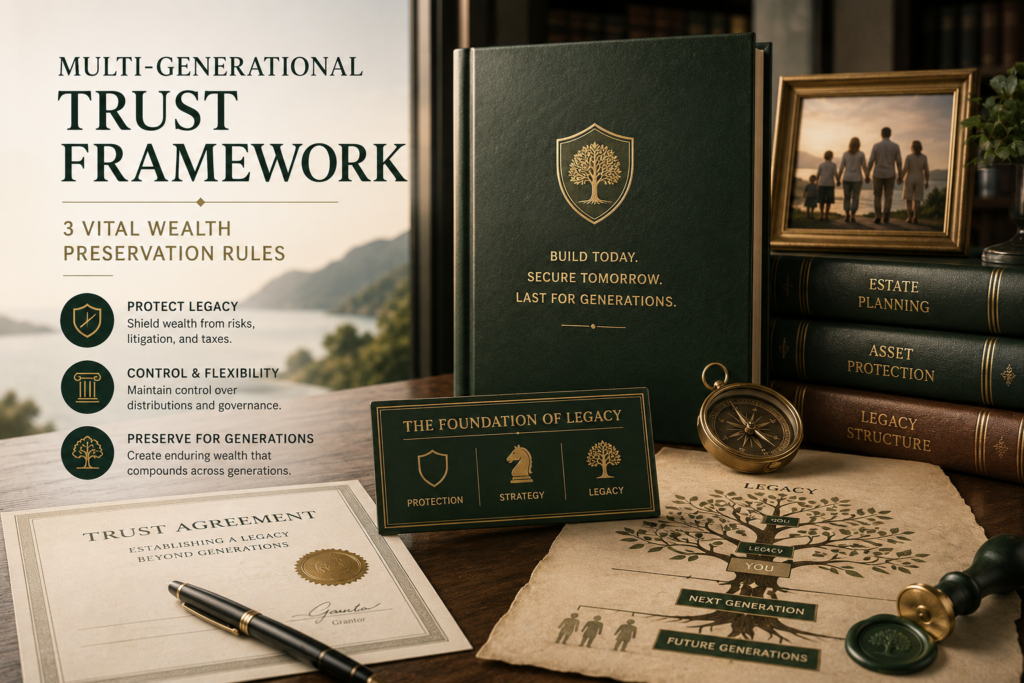
To fully secure your family’s capital positions through a multi-generational trust framework, wealth managers must implement three critical estate-preservation guidelines:
- The Asset Separation Principle: True protection requires abandoning direct personal ownership. Moving capital positions into an autonomous fiduciary shell shields assets from personal creditors and legal claims.
- The Multi-Tier Distribution Factor: Trust documentation should utilize staggered age milestones or incentive-based parameters to prevent sudden capital drops from immature beneficiary spending.
- The Tax Arbitrage Rule: Trust setups must actively leverage regional tax exemptions—such as US lifetime gift exclusions or UK business property reliefs—to protect capital entries from heavy tax leaks.
When evaluated through a rigorous wealth architecture framework, establishing a multi-generational trust framework delivers a highly secure asset pipeline. This approach removes your hard-earned investments from public probate processes, ensuring absolute confidentiality and immediate liquidity distribution for your family during transitional seasons. Managing family capital through these institutional setups allows you to focus your attention on expanding current business operations, knowing that your long-term legacy remains secure.
3. Comparative Structural Modeling: Trust Vaults vs. Outright Inheritance
To understand the strategic advantages of fiduciary shielding, we must analyze how capital responds to disruptive events under different legacy systems. Current legal and legislative updates from the US Internal Revenue Service and the UK HM Revenue & Customs reveal how unprotected estates suffer significant value reductions during generational transitions.
The comparative matrix below shows how a multi-generational trust framework consistently outperforms standard outright inheritance across an initial $2,000,000 family capital pool, charting key parameters like tax protection, creditor shielding, and spendthrift insulation.
| Risk Variable Scenario | Standard Outright Inheritance | Multi-Generational Trust Framework | Dominant Structural Vector |
|---|---|---|---|
| Generational Tax Exposure | Subject to repeated Estate Tax / IHT hits | Tax-sheltered growth across generations | Trust Shield Protection (100%) |
| Creditor / Litigation Claims | Heir’s personal assets are fully exposed | Impenetrable shield from personal lawsuits | Complete Capital Isolation |
| Divorce / Marital Dissolution | Inherited capital risk in marital splits | Kept strictly as separate non-marital asset | Bloodline Preservation Lock |
| Probate Court Processing | 9–24 Month Delays (Public Record) | Instant, Private Fiduciary Transition | Absolute Operational Speed |
| Spendthrift Asset Destruction | Total risk of rapid unmonitored spending | Staggered, incentive-based distributions | Engineered Capital Longevity |
This systematic breakdown shows that using a multi-generational trust framework prevents your family’s core investments from being exposed to personal financial vulnerabilities. For portfolios intended to sustain family lines across multiple decades, relying on simple wills is an unacceptable risk. Implementing a dedicated trust structure ensures your wealth remains secure, private, and structurally isolated from external disruptions.
4. Advanced Playbook: The Structural Legacy Protocol (SLP)
To integrate this comprehensive protection into your wealth ecosystem without creating unnecessary operational friction, we abandon overly restrictive legal templates. Instead, our brand architecture utilizes a modern blueprint called the Structural Legacy Protocol (SLP). This system splits your fiduciary planning into three separate modules:
Module 1: Clear Fiduciary Governance
Governance involves selecting the right entities to manage and protect your trust assets over time. Relying solely on an individual family member frequently leads to emotional conflicts, administrative errors, and unexpected legal issues. The SLP recommends a Hybrid Trustee Infrastructure: appointing a professional corporate trustee to handle complex tax reporting, paired with a trusted family member or an independent Trust Protector to oversee distribution approvals and retain amendment powers.
Module 2: Staggered Capital Distribution
Distribution architecture manages how assets flow out to beneficiaries without threatening the core principal pool. Rather than releasing large lump sums at arbitrary ages, the protocol uses a Metric-Based Distribution Design. Capital flows are split into narrow, functional tranches: covering verified higher education costs directly, providing proportional matching funds for business startups, and deferring discretionary principal access until specific maturity milestones are met.
Module 3: Asset Contribution Sequencing
The final module focuses on the strategic funding of your trust shell. Funding a multi-generational trust framework requires careful timing to optimize tax efficiencies. This involves systematically transferring highly appreciative assets, private business equities, or specialized insurance lines into the trust over time, utilizing your annual tax exclusion limits to maximize capital protection automatically.
Deconstruct Your Legacy Preservation Metrics
Do not leave your multi-generational wealth exposed to probate delays or heavy estate tax leaks. Use our interactive analytical tools to calculate your exact estate tax exposure, structural savings, and asset projections down to a single basis point.
5. Aligning Asset Architecture with On-Site Calculation Systems
An estate preservation strategy is only truly effective when paired with regular, objective financial calibrations. To evaluate how much capital your household can comfortably allocate to long-term trust shells and optimize your overall funding pipeline, you must analyze your near-term cash requirements. Using advanced calculators ensures your legacy goals align perfectly with your daily cash flow needs.
We recommend utilizing our custom calculators to audit your portfolio metrics and optimize long-term efficiency:
- Isolate Surplus Capital: Use our Monthly Budget Calculator to determine your precise monthly expenditure trends and isolate the cash flows available for trust funding.
- Project Multi-Generation Wealth: Input your prospective trust asset balances into our Savings Goal Calculator to visualize how tax-sheltered compounding will expand your family’s capital across future generations.
By inputting your unique income streams, fixed liabilities, and core asset positions into these calculation modules, you transform standard estate planning into a highly optimized personal wealth system.
6. Multi-Generational Trust Framework Definitive Frequently Asked Questions
Can a grantor modify an irrevocable trust within a multi-generational trust framework?
By default, an irrevocable trust cannot be easily amended or terminated by the grantor once established, as this clean separation is exactly what grants the asset protection and tax advantages. However, modern trust legal designs frequently include a role known as a Trust Protector. This independent third party can be granted specific legal powers to amend trust terms in response to major legislative tax updates or unexpected shifts in beneficiary needs, maintaining essential flexibility within your secure structure.
What asset types are most effective for funding a multi-generational trust framework?
The most optimal assets for trust funding are those with high long-term appreciation potential, such as early-stage private business shares, real estate holdings, or broad-market equity lines. Transferring these assets into the trust early allows all future growth to occur entirely outside of your personal taxable estate. Additionally, specialized permanent life insurance policies are highly efficient funding tools, providing large, tax-free cash inflows to the trust to support future generations.
How does a trust protect family wealth from marital dissolution risks?
When assets are held properly within a multi-generational trust framework, the beneficiaries do not have direct, personal ownership of the underlying capital. Because distributions are entirely at the discretion of the trustee, the trust assets cannot be classified as personal marital property during divorce proceedings. This legal architecture protects your family’s foundational investments from being divided or compromised in external marital separations, keeping your core legacy intact.
Prioritize your capital protection early on. Build a resilient sovereign legacy foundation, and allow long-term compounding to grow your family’s wealth safely across generations.